KKT Services · Skills & Capabilities
Engineering capacity demonstrated through delivered work
A catalogue of the analysis types and methods applied on offshore foundation, monopile, jacket and substation projects — from non-linear and impact FEA to AI-accelerated concept design and Workbench automation. Click any image to view full size.
Offshore foundations & structural analysis
SCF — Tubular joints (jackets)
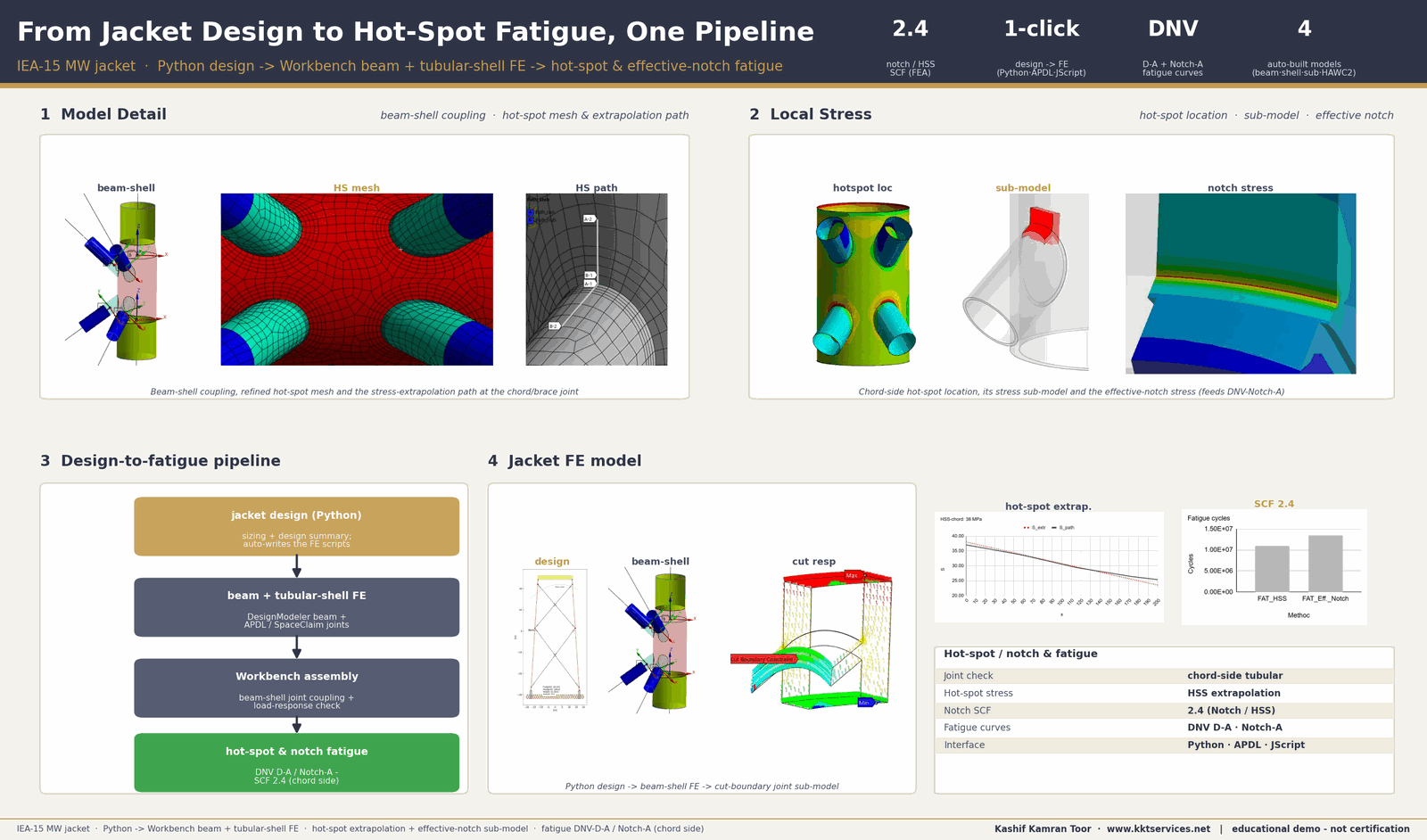
Stress concentration factor evaluation at tubular K, T and X joint intersections — the input to jacket joint fatigue assessment per DNV recommended practice.
Pile–soil interaction
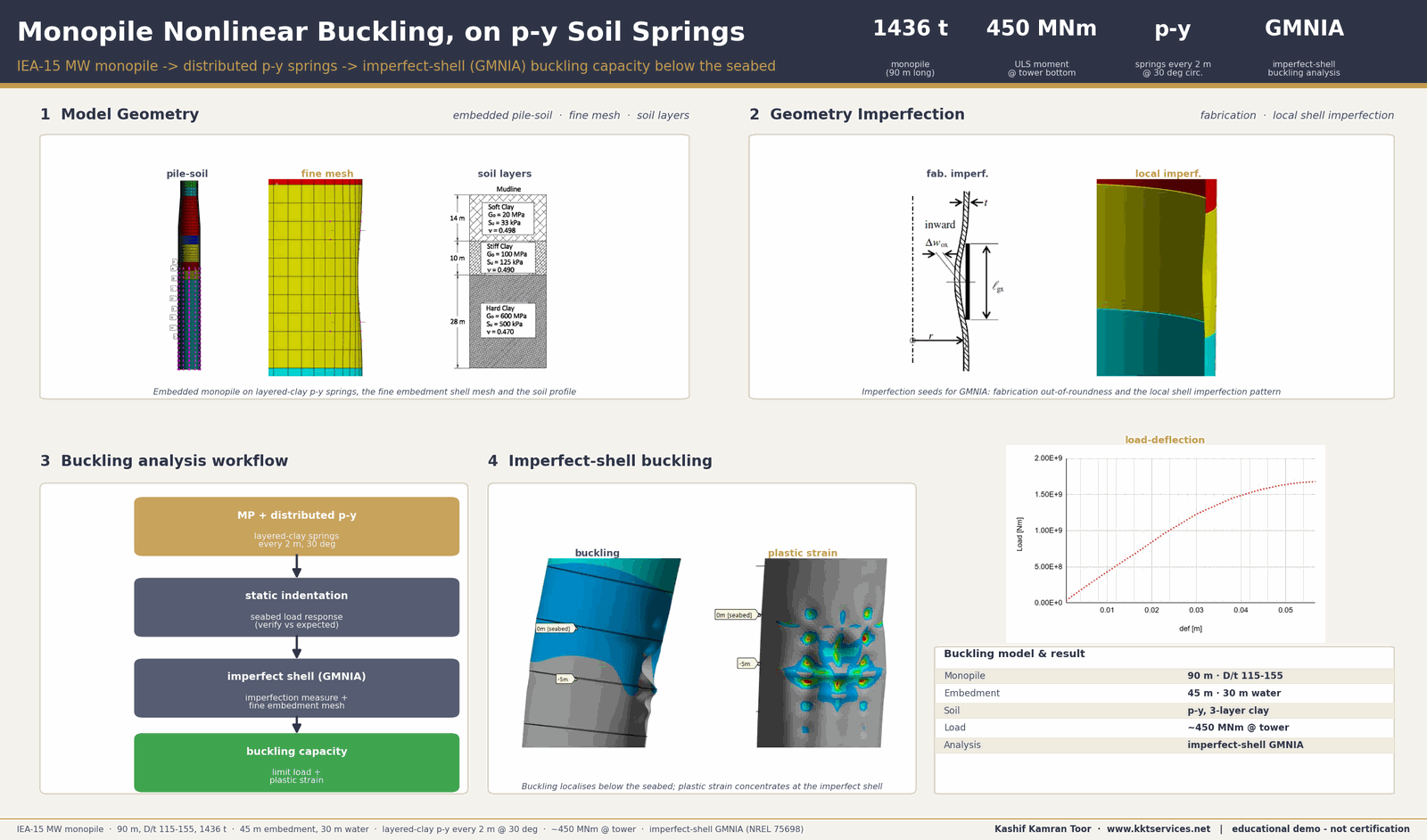
Soil–pile interaction modelling with p–y, t–z and Q–z curves for monopile and jacket pile capacity and stiffness — implemented in ANSYS for integrated structural checks.
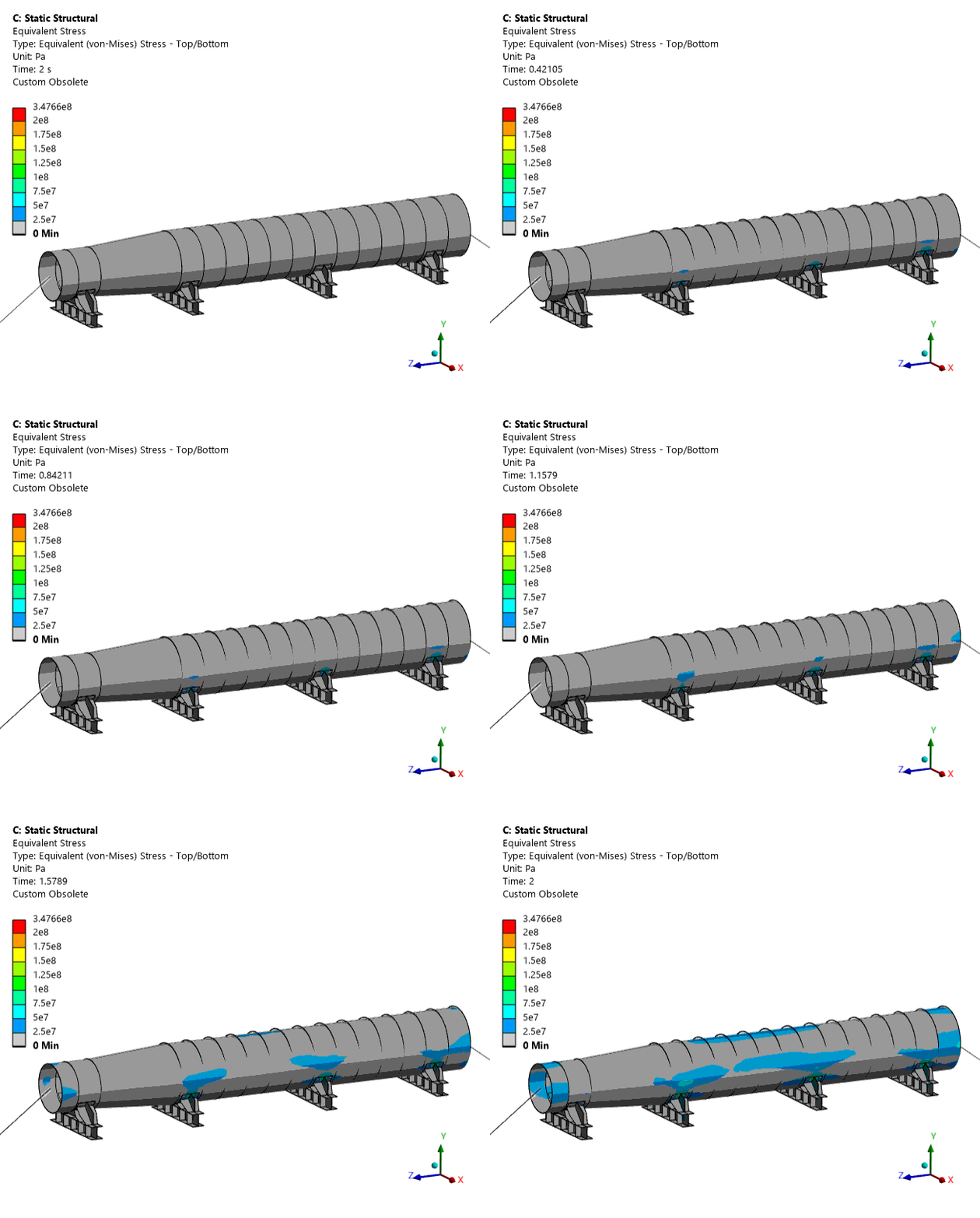
Monopile sea-transportation
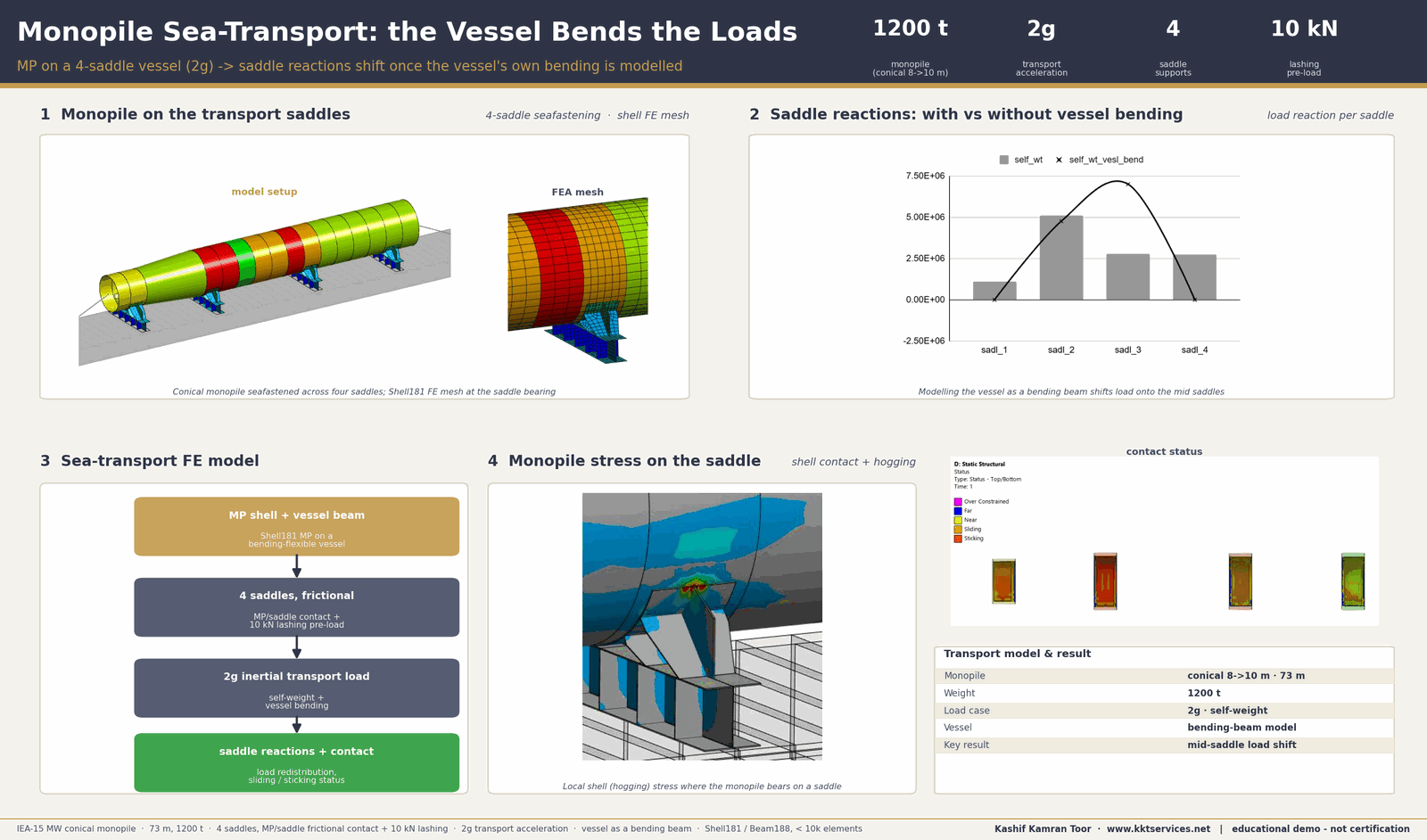
Monopile sea-transportation assessment including vessel hogging/sagging response and structural acceptance against fabrication and lashing tolerances.
Advanced & non-linear FEA
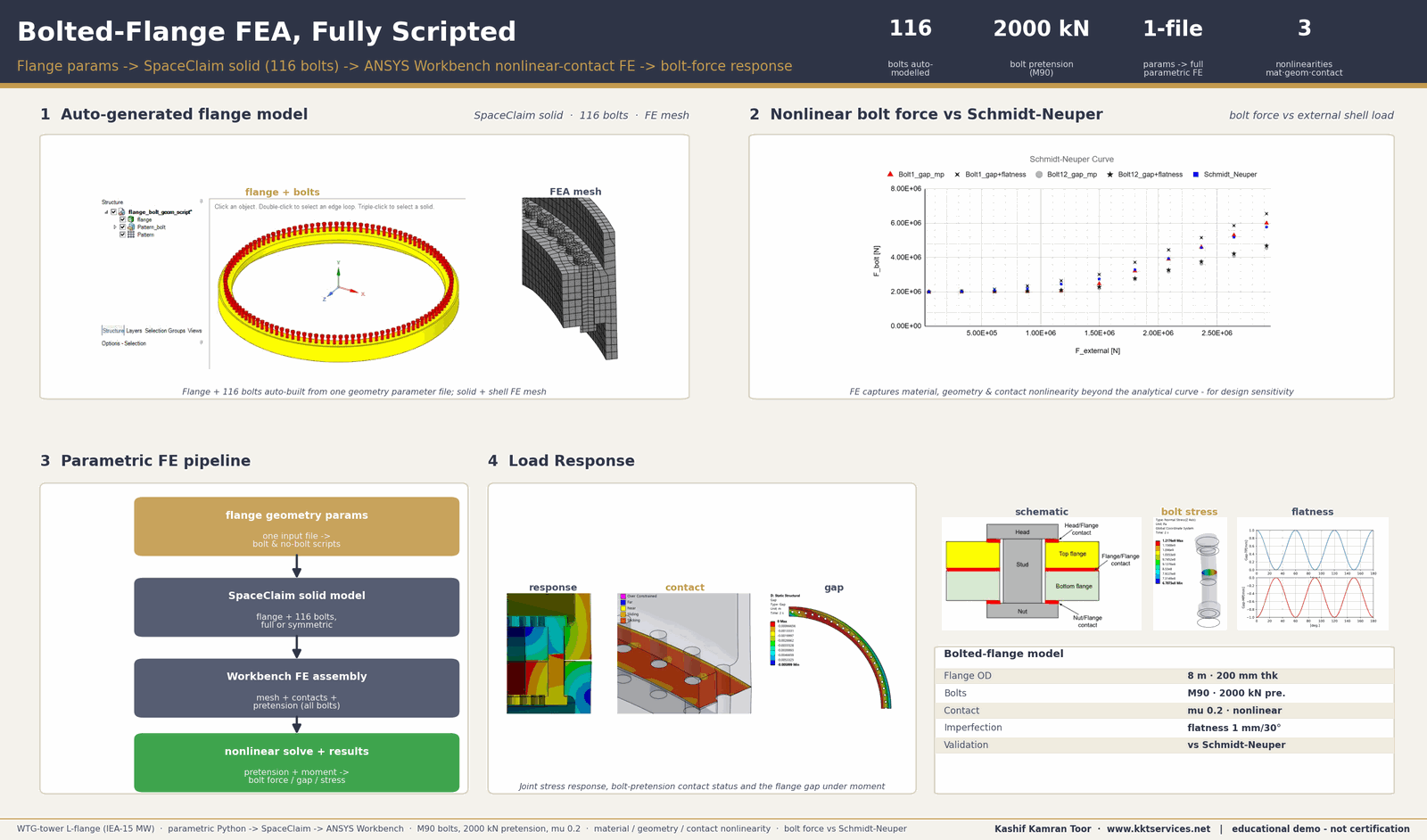
Bolted-flange FEA (WTG)
Bolt and flange detail FEA for wind-turbine generator connections — pretension, contact, gap behaviour and pre/post-yield bolt response with non-linear material data.
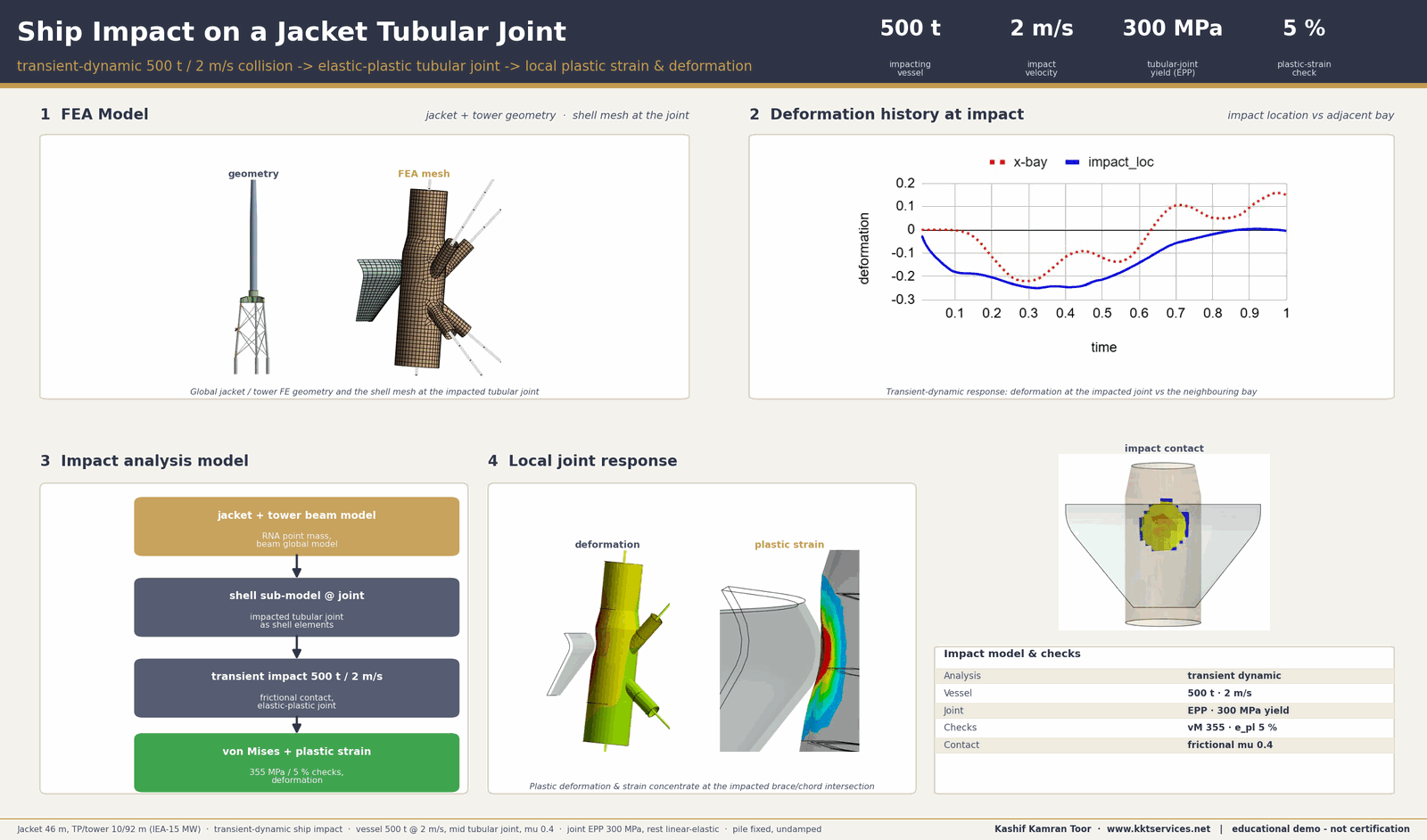
Vessel impact on jackets
Ship-impact analysis on offshore jackets combining ANSYS implicit pre-load and LS-DYNA explicit collision response — local plastic deformation, energy absorption and global integrity.

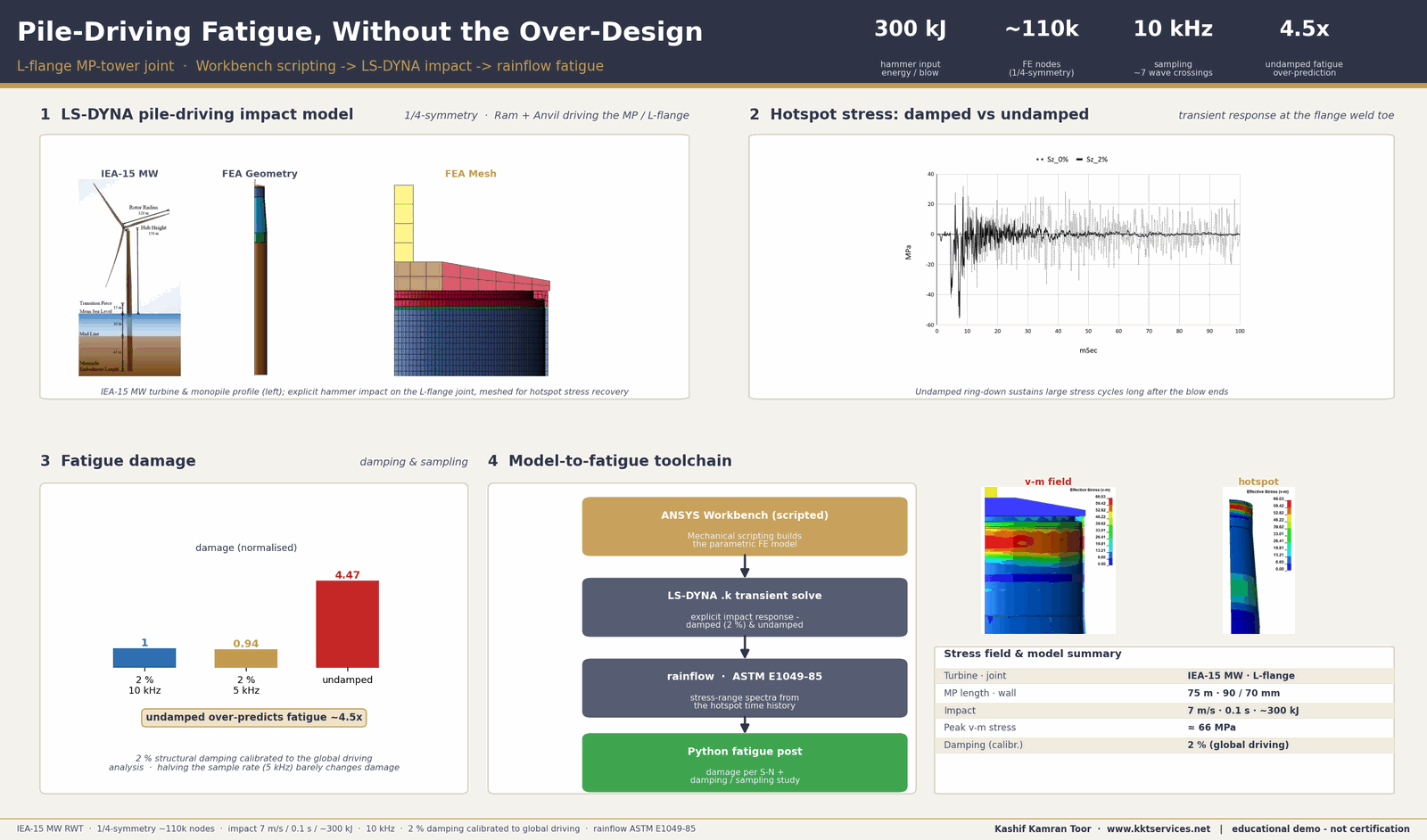
Pile driving (LS-DYNA)
Explicit pile-driving simulation for monopile installability — hammer–pile–soil interaction, driveability checks and driving-induced stress histories.

AI/ML, automation & post-processing
AI-accelerated design & FEA
Machine-learning surrogates embedded in the analysis workflow — concept-stage geometry, mass and impact prediction in minutes instead of full FE runs. See the live tools in the toolkit.
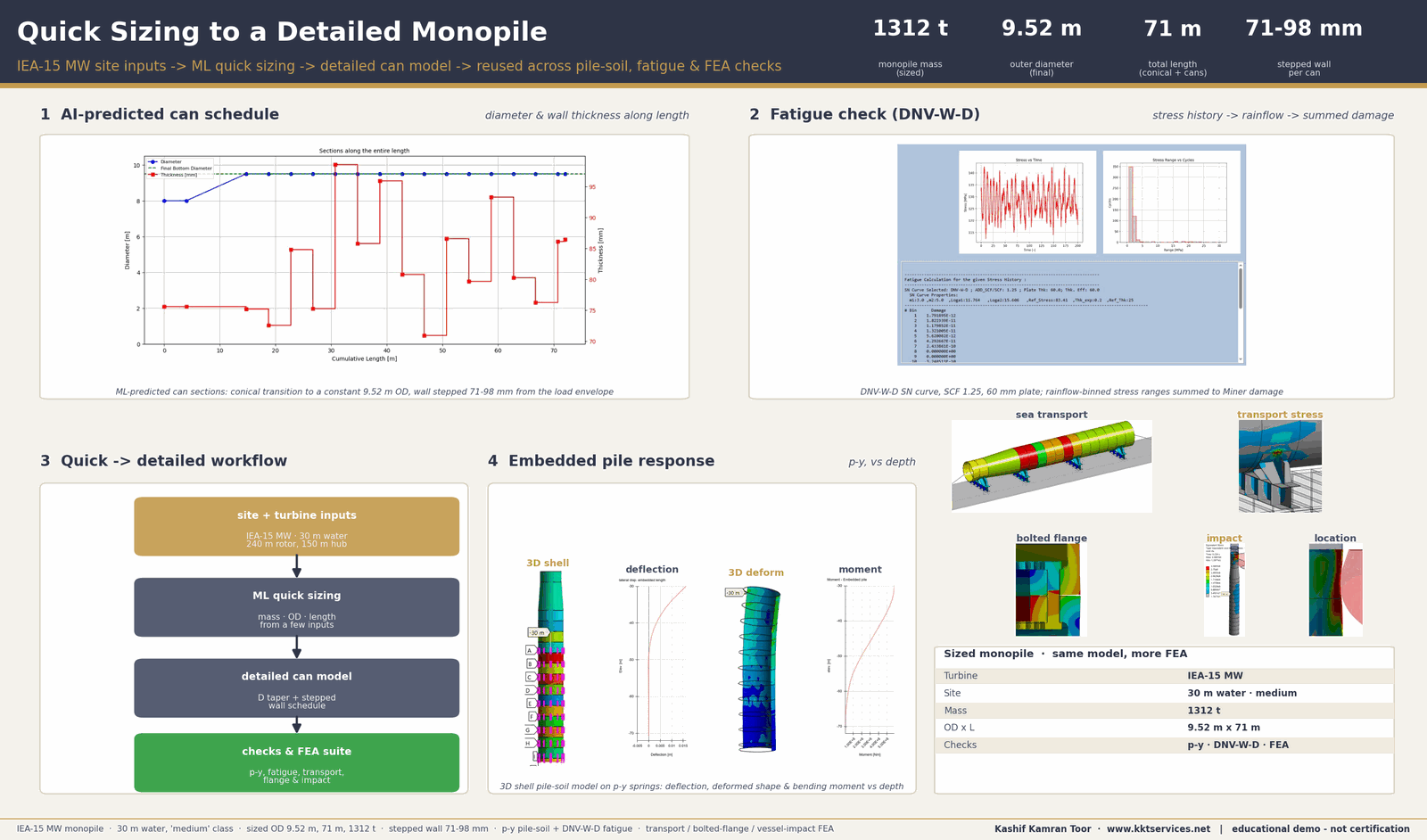

Park-wide sizing & foundation CAPEX
Machine-learning sizing applied across an entire wind farm, then priced by a transparent bottom-up cost model — from site layout to an investor-ready foundation CAPEX in minutes, with the ML estimate surfaced as a cross-check against the reported basis.

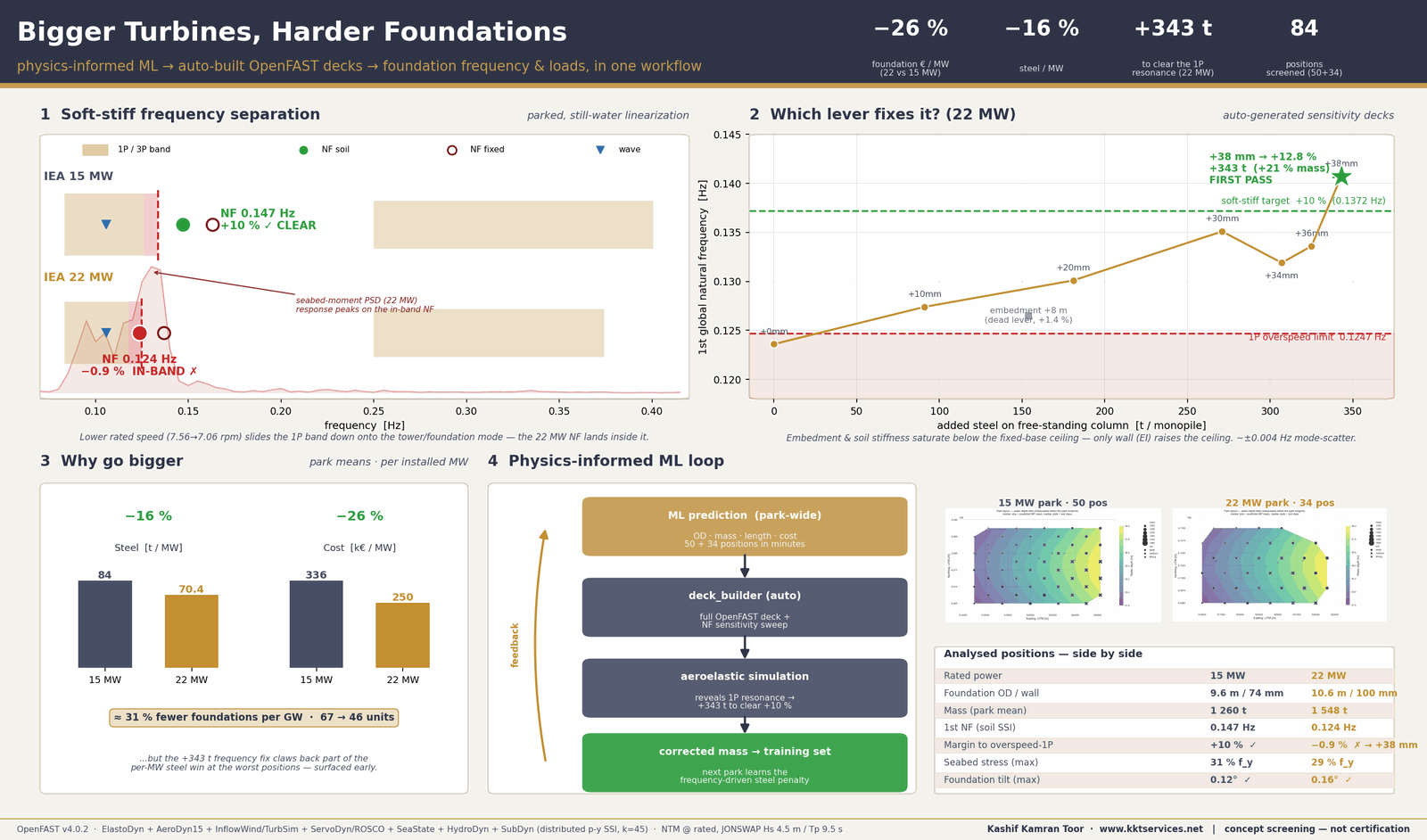
Turbine up-scaling & frequency separation
Physics-informed ML driving auto-built OpenFAST decks to screen foundation natural frequency and loads as turbines scale — quantifying the soft-stiff 1P/3P separation and the steel penalty of moving from a 15 MW to a 22 MW rotor across a park.
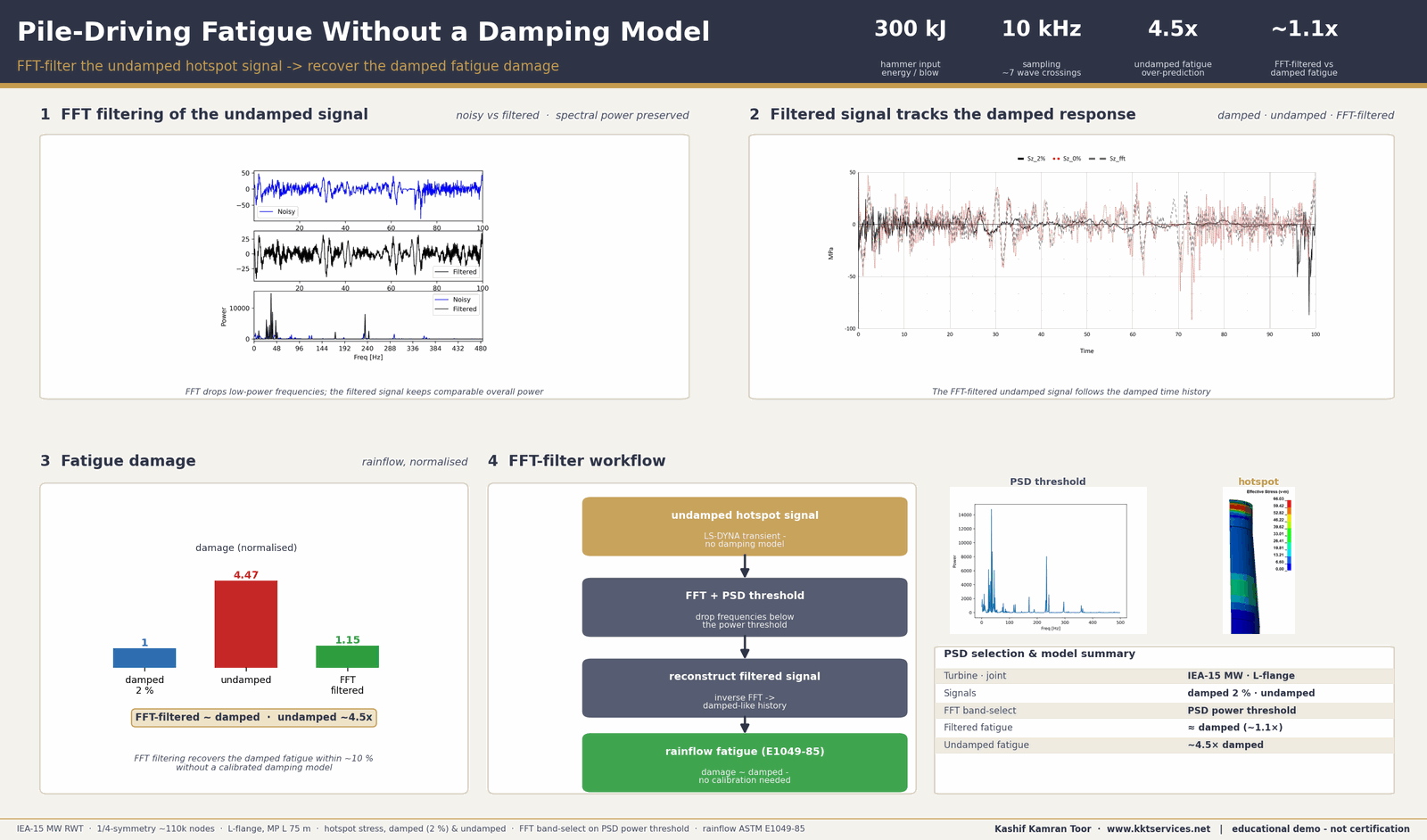
FFT — dominant response for fatigue
Frequency-domain analysis to isolate dominant response bands for fatigue post-processing of long time-history signals, including pile-driving stress histories.
Decision analysis & methodology
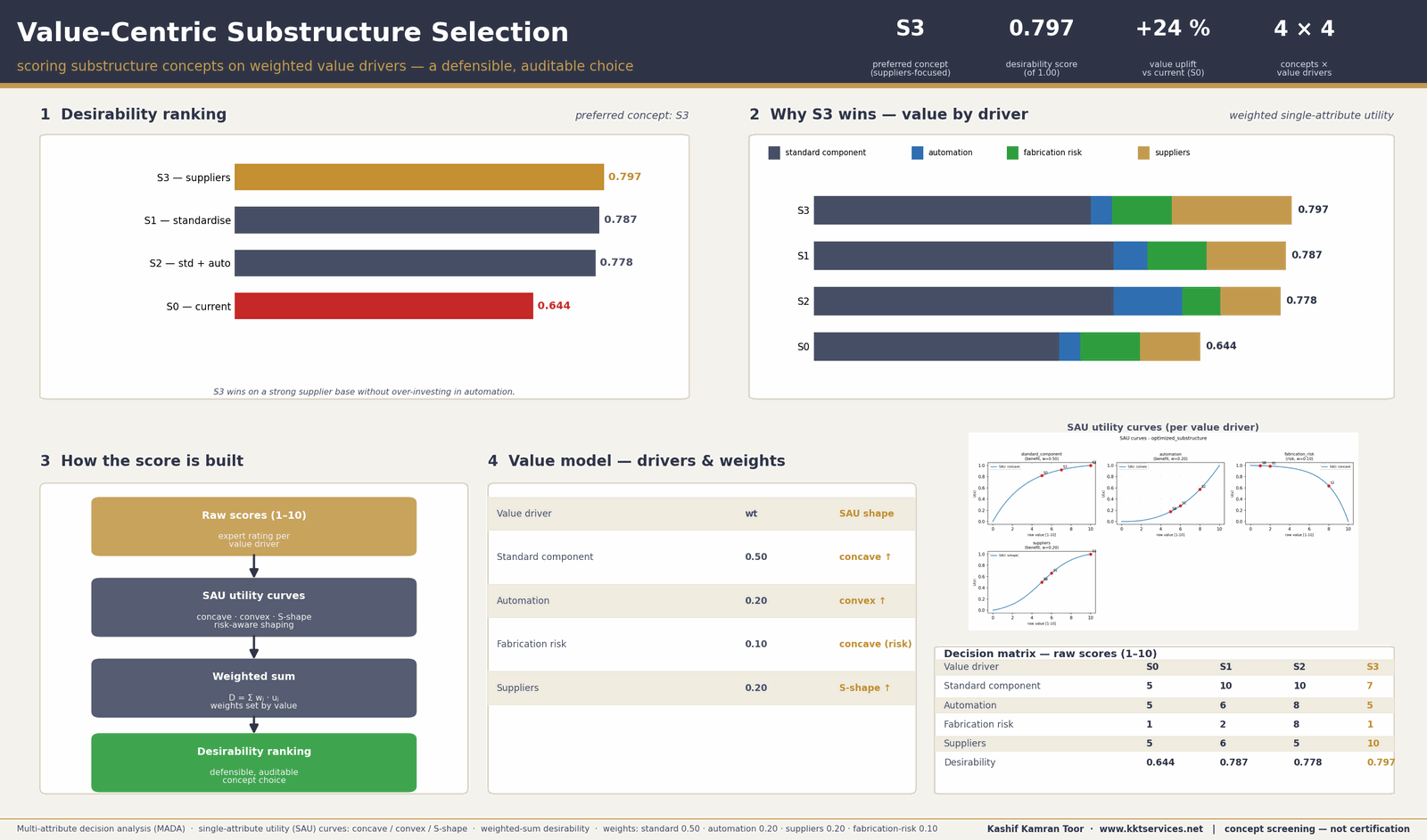
Value-Centric Decision (MADA)
Multi-attribute decision analysis for quantitative concept screening — weighted comparison across cost, mass, manufacturability, risk and certification, with optional single-attribute utility (SAU) curves. Applied at Vattenfall for early-phase design selection; available as a live tool.
Condition monitoring & O&M
Structural health monitoring
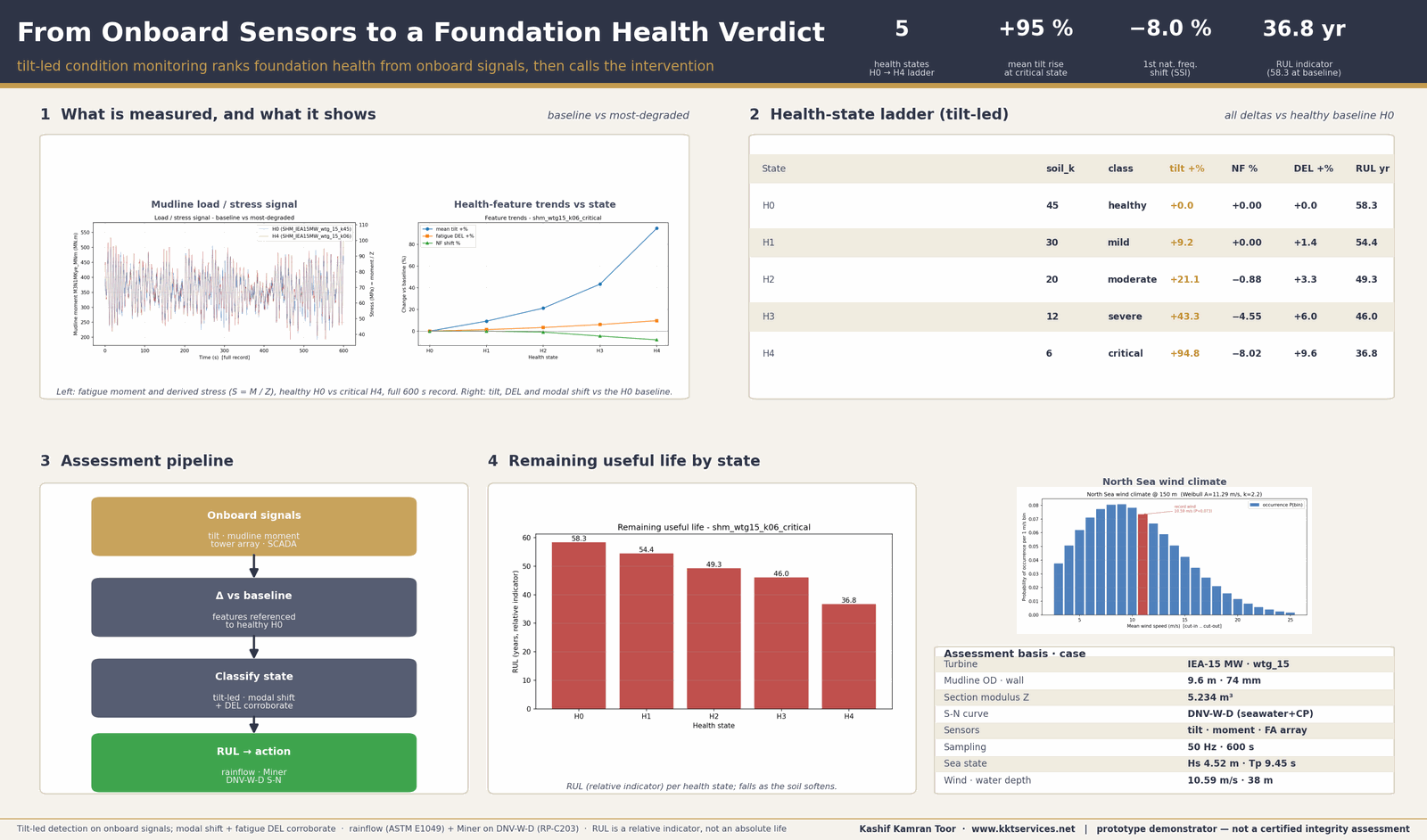
Physics-informed condition monitoring that ranks a foundation against its own healthy baseline from onboard tilt, mudline moment and accelerometer signals — mean tilt leads detection, modal shift (SSI-cov) and fatigue DEL corroborate, and a remaining-useful-life indicator drives the maintenance call. Prototype demonstrator developed from an MIT xPRO capstone; not a certified integrity assessment.